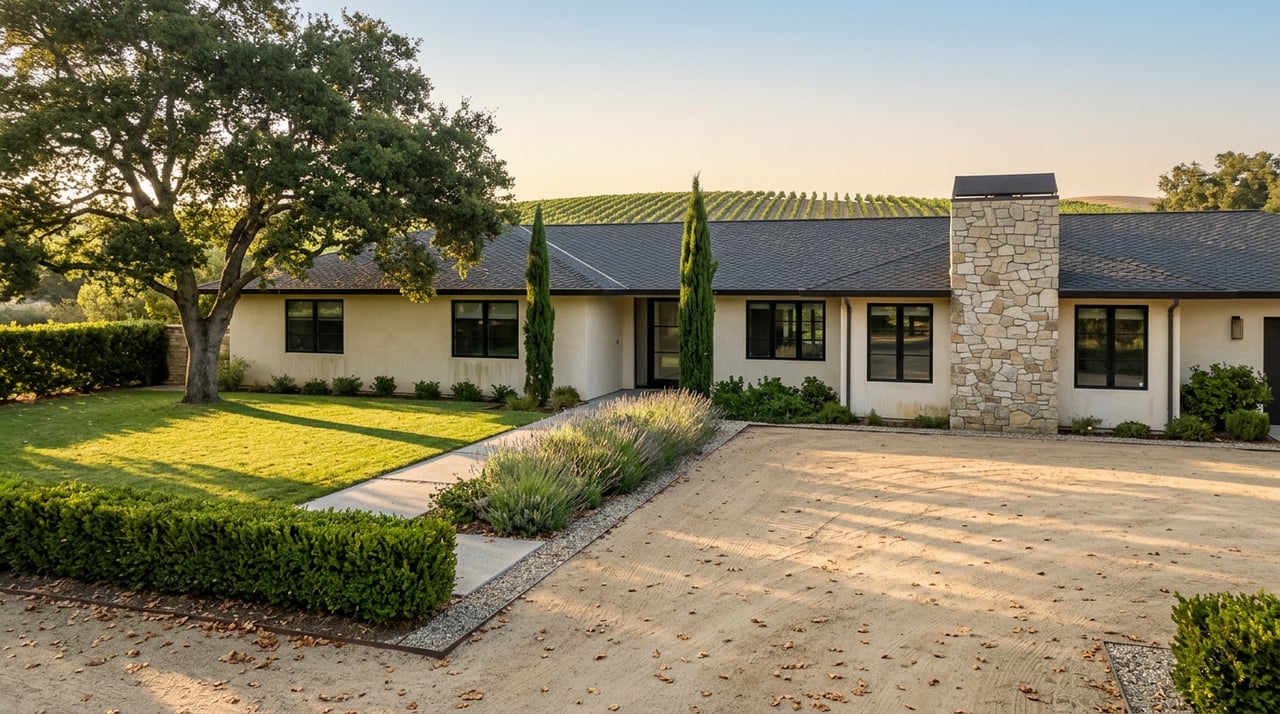
Windsor, CA Home Prices: How the Growth Boundary Shapes the Split
September 24, 2026
September 24, 2026
If you've been watching Windsor listings this year, you've probably noticed something that doesn't add up. Homes on one side of town are selling in under three weeks with prices climbing into the double digits. On the other side, homes are sitting closer to five weeks and prices are actually easing back. Same town. Same school district boundaries in many cases. Same wine country zip code. Two completely different markets.
The instinct is to blame this on lot size, or renovation quality, or which streets happen to be trading this month. Those things matter. Another factor shaping supply is the growth boundary Windsor voters approved in January 1998; a separate town ordinance caps annual construction at 150 homes.
Windsor incorporated in 1993 specifically because the town wanted more control over its own growth. Within five years, voters had approved an urban growth boundary by a 72 percent margin, a line around the town that development cannot cross. It was written to last twenty years. In 2017, Windsor's voters renewed it again, this time for another 22 years, which pushes the boundary out to 2039.
Alongside that boundary sits a second, less-discussed piece of policy: a town growth ordinance that caps new home construction at 150 units per year. Not per neighborhood. Per year, for the whole town.
150 homes a year. That's the entire allotment for new construction in Windsor, a town of roughly 26,000 people, fixed by an ordinance. The town's voters have renewed its growth boundary through 2039.
Together, the boundary and annual cap shape the pace and location of new housing. New supply is directed to areas identified in the town's area plans, rather than necessarily following where demand is highest in a given year.
Windsor directs almost all of its permitted growth into three specific corridors: Old Redwood Highway, Shiloh Boulevard, and downtown. Each of these carries a Compact Residential zoning designation that allows 12 to 32 units per acre on lots as small as 3,000 square feet.
Downtown has already absorbed most of what it's going to. The New Urbanist village built around the old train station brought more than 130 condominiums and 50 businesses into the core by 2006, anchored by the five-acre Town Green that opened in 2001. That corridor is largely built out. Which means the pressure now sits on Shiloh Boulevard and Old Redwood Highway, and on whatever handful of projects happen to be working through approval at any given time.
Right now, that handful looks like this:
Notice what's missing from that list: ordinary, market-rate, detached single-family homes on standard lots. Almost everything in Windsor's current pipeline is either age-restricted, income-restricted, rental, or transit-oriented. Only Ross Ranch Estates offers anything close to the large, private lot that a move-up buyer is typically shopping for, and it's still sitting in staff review.
Here's what that pipeline gap looks like when you compare Windsor's two Redfin-tracked submarkets side by side.
| Metric | East Windsor | West Windsor |
|---|---|---|
| Median sale price | $805K (3 months ending May 2026), down 1.1% year over year | $973K (March 2026), up 13.7% year over year |
| Price per square foot | $479, down 4.9% year over year | Not separately reported, average home price $940K, up 17.5% year over year |
| Days on market | 32 days, down from 39 a year earlier | 18 days, down from 58 a year earlier |
| Homes sold | 41 in May 2026, down from 52 a year earlier | 8 in March 2026, down from 12 a year earlier |
Read that table straight and it looks contradictory. East Windsor is selling faster than a year ago but at slightly lower prices. West Windsor is selling dramatically faster and at meaningfully higher prices, on a much smaller pool of transactions. Town-wide, Windsor's overall median sat near $774K as of September 2026, down about 2 percent from both the prior month and the prior year.
None of those three numbers, taken alone, tells you the truth. Together, they describe two mini-markets moving in opposite directions inside the same calendar year, inside the same town, inside the same growth boundary.
If one side of town runs hot, builders and sellers may respond by pushing more inventory toward it. In Windsor, that response is limited by the annual cap and area plans. Permits are rationed for the entire town, and the corridors where those permits are allowed to land are fixed by area plans, not by where buyers happen to be bidding this year.
That's why the composition of the pipeline matters more here than in a typical Sonoma County market. Cora Creek and Redwood Glen add rental and income-restricted units near the Old Redwood Highway and SMART station corridors. Those units don't compete with the resale detached homes driving West Windsor's median higher, so they won't move that number even once they're built. Shiloh Village adds senior housing and retail, also outside the price tier that's currently accelerating.
Ross Ranch Estates could add supply to West Windsor's price tier because it's the only large-lot, market-rate subdivision in the current pipeline. It's also the one still furthest from breaking ground. The boundary and the cap shape how much new housing can be built and where it can be located, while the listed projects serve different housing types and price tiers.
If you're cross-shopping Windsor against Santa Rosa, Healdsburg, or Petaluma using a single median price, you're comparing a number that's doing something unusual behind the scenes. Windsor's median isn't smoothing out normal market noise. It's averaging two submarkets that are being supplied by policy, not by builders chasing demand.
Practically, that means a few things worth checking before you anchor on any headline figure. Ask which side of town a listing sits on, not just its list price. Ask whether any of the four projects above are near it, and what kind of housing each one actually adds, because a 106-unit rental building a half mile away tells you something very different than a 31-lot estate subdivision would. And if you're selling into the tighter side of this market, consider how the boundary, which town voters extended through 2039, shapes the pace and location of additional supply.
That's the kind of context that doesn't show up on a portal listing, and it's exactly the kind of thing worth talking through before you price a home or make an offer in this town. If you'd like a clearer read on where your street sits inside this pipeline, or you're weighing whether now is the right moment to list on the tighter side of Windsor, reach out to Rhonda Alderman to request your complimentary home valuation. Two decades of watching Sonoma County's town-by-town quirks play out is exactly the kind of detail that belongs in your pricing conversation, not left out of it.
Does the growth boundary mean Windsor will eventually run out of room to build? Not exactly. The boundary limits where growth can happen, not whether it happens at all. Windsor still has approved capacity inside its three designated corridors. What the boundary and the 150-home cap do is control the pace and the location, which is why supply additions show up unevenly rather than all at once.
Will Cora Creek or Redwood Glen bring prices down once they're finished? Probably not for detached, market-rate resale homes. Both are rental or income-restricted projects aimed at a different segment of the market. They add housing stock and ease overall demand pressure on rentals, but they aren't the kind of inventory that competes directly with a single-family home purchase.
Is one side of Windsor a better long-term buy than the other? That depends entirely on what you're trying to buy and hold, and it's the kind of question that benefits from a conversation about the specific street and price tier rather than a general rule. The pipeline detailed here is a good starting point for that conversation, not a substitute for it.
This article is general information, not legal, tax or financial advice. Consult a qualified professional about your situation.
Stay up to date on the latest real estate trends.

Rhonda enjoys spending the critical time in understanding her clients’ specific needs and concerns. Contact her today so he can guide you through the buying and selling process.